Friday, February 10, 2012

Houston poised to become California CO2 trading hub

London, 1 February, 2012: Reuters

California will next year host the world’s second biggest CO2 market as it tries to roll back its carbon footprint two decades, but it will not be San Francisco or Los Angeles that will be the center of trade, but the U.S. oil-dealing hub in Texas. Home to dozens of oil, gas and power firms, the city of Houston stands to emerge as the nerve center for trade in California emission permits when the market starts in 2013.

In an ironic twist, ICAP Energy, Vitol and JP Morgan, as well as several other international banks, will run desks aimed at cutting emissions while sitting in offices in the country’s biggest polluting state.

“At this point, California carbon is being seen largely as an extension of the energy business and Houston is the main hub for energy,” said Henrik Hasselknippe, director of global project development at the Green Exchange (GreenX).

Banks, brokers and trading houses will join nearly one dozen Houston-based power, oil and gas companies who will face caps under California’s cap-and-trade scheme and trade permits from Texas.

“It’s very safe to say that Houston should have a vibrant capacity to do some carbon trading, specifically for the California market, specifically because we have a vibrant energy trading sector here,” said Mithun Rathore, a broker at Amerex.

Companies subject to caps “are already attributing or correlating carbon compliance with west coast power trading, so there is a good number of companies assigning their carbon trading to their west power traders, who are pricing (CO2 permits) into the forward curve,” he added.

Some observers said while New York is a more suitable base for financial trade, specialized energy-related commodities, such as carbon, have a hard time competing there.

“The carrying costs of New York are very expensive. When you compare (carbon trading) to the benefits from general financial trading – it may not be enough to compete,” said Victor Flatt, an environmental law professor at the University of North Carolina.

TESTING THE MARKET

Trade in California Allowances (CCAs) has been piecemeal so far, but analysts predict activity will take off in the second half of the year, when companies facing caps are cleared to begin buying pollution permits.

Investment bank Barclays Capital was an early player in the California carbon market, having traded the first forward CCAs in November 2010, but has since closed its New York emissions trading desk citing the uncertain regulatory environment and poor margins.

But Barclay’s move to close operations is not a common trend seen at other institutions.

One vice president of power and gas at an international bank who requested anonymity said his team “has to follow” California carbon, but has so far only bought a small amount of allowances in preparation for a larger market.

Meanwhile, Fabio Nehme, general manager for environmental products at the Houston office of energy company EDF Trading’s, said his firm was “getting organized” to be able to engage more actively in the market once trading volume becomes more robust.

Amerex’s Rathore said he expects the larger California emitters in the power sector to start becoming active in pre-compliance trade by the second quarter of the year, ahead of the first auction of CCAs.

But liquidity should increase later this year or next year when large energy companies who export oil and gas to California, prepare join the mandatory market in 2015.

“It’s smart to start understanding the market early,” he said. “Once the clock starts ticking you want to make sure you are not caught with your pants down.”

Some observers expect carbon trading activity to move westward after traders get their feet wet in California emissions trading in the program's early years.

CALIFORNIA JOBS

Tim O'Connor, director of California climate policy for the Environmental Defense Fund', said it is natural for trading to start in Houston because there is an infrastructure already in place.

But as demand for permits increases, he said he expects California's cities to create new jobs for for lawyers, consultants and traders who understand the state's market regulations.

"I think what we will see is increasing pressure for people who are here in California who know the California landscape and how the market works," he said.

He added that despite the fact that some California carbon market jobs will be based in Houston, it does not mean "green jobs" will be lost in the state -- a criticism of opponents of cap-and-trade.

O'Connor said the program will generate new jobs in companies specializing in energy efficiency, renewable energy and clean technology.

California carbon trading at $15

Following news that the state’s largest emitter was looking to purchase carbon allowance and offsets, California carbon allowances (CCAs) saw prices rise to $15 per ton.

The Intercontinental Exchange saw 130,000 CCAs trade this week after Pacific Gas & Electric announced it was looking to buy a substantial amount of carbon to meet new state requirements beginning in 2013.

Carbon offsets saw a very busy week as well, with 180,000 Ozone Depleting Substances (ODS) credits trading at upwards of $9

Friday, January 27, 2012

The EPA Works to Finalize its Allocation and Production Rights for HCFC-22 for 2012-2014

There has been much recent discussion regarding the market for HCFC-22 in 2012, as the EPA works to finalize its allocation and production rights for 2012-2014. Here are some basic facts HARDI wanted to communicate to our membership.
 
1.)    There is an ongoing EPA rulemaking concerning the allocation of refrigerants, including R-22 for 2012-2014. The EPA has suggested a reduction of allocation rights of R-22 between 11% and 47% in each year (2012-2014), in addition to the annual 10% reduction each of those years set by the 2009 Allocation Rule. EPA’s proposed reduction was not unexpected, and is supported by some industry stakeholders.

2.)    Since the current rule is not final, it is illegal for a company with 2011 allocation rights to produce or imports HCFCs into the United States until receipt of a “non-enforcement” letter from EPA which was expected by many companies to arrive the first week of January; however this letter was delayed until Friday, January 20. Thereby, 15 work days had passed where no refrigerant production or importation occurred.

3.)    In this “non-enforcement” letter, EPA stated that production and importation should be limited to approximately 17% of a company's 2011 baseline until the rulemaking is complete. If, when the rulemaking is completed, the final reduction is less than 17% of the 2011 baseline, a company will be allowed to increase production and importation to their allocated limits. HARDI does not expect this rulemaking to be completed by the beginning of summer.

4.)    From 2005-2010 (2011 data is not yet available), only 77% of Consumption Allowances for HCFC-22 were used. These figures along with comment from stakeholders to the EPA, regarding the oversupply of R-22 in the marketplace and concerns of stockpiling, have led EPA to consider a more aggressive phasedown.

5.)    In 2011, EPA sought comment from the Alliance for Responsible Atmospheric Policy, of which HARDI and all major refrigerant producers are members, regarding a suggestion for a more aggressive reduction in R-22. The Alliance formally submitted a suggestion for a 20% reduction in Consumption Allowances.   

HARDI’s Refrigerants & Refrigeration Council is currently accepting member comments on what the annual reduction should be in this rule. 

Thursday, January 19, 2012

Eco-friendly car refrigerant 'turns into deadly gas it vehicle catches fire'

By , Paris

7:34PM GMT 17 Jan 2012

A new "eco-friendly" car refrigerant expected to become the industry standard turns into a deadly gas if the vehicle housing it catches fire and should be shelved, it has been claimed.

The coolant for car mobile air conditioning systems, called HFO-1234yf, has been approved for use in the US, Japan and Europe and Toyota and Suburu have started fitting their cars with the substance.


It was chosen as it is produces 98 per cent less climate damaging that its predecessor, R134a.

However, a German expert on the compound has warned that it is should be scrapped as it is much more flammable than the current coolant and when heated above 500C (932F) releases hydrogen fluoride, a highly toxic gas. Temperatures in car fires can easily reach twice that heat.

"You have 600g of this cooling agent per car, which if it burned completely would produce 200g of hydrogen fluoride at a level of concentration that is very high. For a human just one gram is deadly – either inhaled in gas form, through the skin or when dissolved in water," warned Prof Andreas Kornath, an inorganic chemistry professor at Munich University who has been studying the substance for 20 years.

The odourless gas has no instant effect but once inside the body a person dies within a day or so in terrible pain due to internal burns and muscle failure.

"This product should not be on the market. There is a real risk every time a car catches fire, which happens 30,000 times per year in Germany alone," he told the Daily Telegraph.

Prof Kornath issued his warning at the European Parliament in Strasbourg.

Honeywell, which produces the product, has refuted the claims.

"The risk of HF formation is not higher than with R134a – and this refrigerant has been used for decades without any recorded incident," said Honeywell's Sabine Chmielewski.

SAE International Cooperative Research Program, which comprises leading automakers, found HFO-1234yf to offer "superior environmental performance" to CO2 while having "the lowest risk for use in mobile air conditioning systems in meeting environmental and consumer needs."

But Prof Kornath alleged the product had been mainly approved on the basis of tests compiled by the chemical makers, not the findings of independent research.

BAM, Germany's Federal Institute for Materials Research and Testing, for instance, had warned of the risks of using it, he said.

He recommended using carbon dioxide as a coolant, as the fire risks and toxic hazards were nil.
Toyota confirmed it would start using the new refrigerant in new models starting this year.
The car maker’s spokesman Jean-Yves Jault said: “We think the new refrigerant is as safe, yet much more environmentally friendly, as the previous one. This was confirmed by the SAE CRP investigation whose outcome we support.”

"We undertook flammability tests and risk assessment with an independent third party institute, and the results confirmed the safety of the new refrigerant.”

He said that that the phenomenon of hydrogen fluoride gas is “not new", and that concentration of fluorine atoms was “actually much higher” in the historic refrigerant, R134a.

Monday, January 16, 2012

California, Quebec plan joint emissions allowance sale

13 Jan 2012 14:27 GMT

Portland, 13 January (Argus) — The Canadian province of Quebec will join California in selling emissions allowances at the first Western Climate Initiative (WCI) allowance auction on 15 August.

The remaining members of the WCI held a stakeholder meeting in San Francisco yesterday in which they announced their commitment to the program. Quebec and California are the only partners of the initiative that have approved regulations to participate in the WCI's regional, multi-sector cap-and-trade system, which is due to begin in January 2013.

The WCI, a partnership of Canadian provinces British Columbia, Manitoba, Ontario and Quebec and the state of California, aims to reduce greenhouse gas (GHG) emissions to 15pc below 2005 levels by 2020 through a carbon trading scheme.

Six US states dropped out of the initiative last year to join an offshoot of the regional climate group that does not have a GHG cap-and-trade program. That group, known as North America 2050, aims to reduce GHG emission through carbon sequestration, sustainable biomass and the development of carbon offset projects.

The WCI partners plan to release recommendations for a final offset system this month. Tim Lesiuk, chairman of the WCI's offsets subcommittee, said the initiative aims to come up with a common set of offset protocols that can be adopted across different member jurisdictions. Each member has the choice to adopt all or some of the protocols.

“We would like to see four to five offset protocols this year,” Lesiuk said.

Quebec plans to adopt offset regulation in spring or summer this year, said Robert Noel de Tilly, senior policy advisor in the climate change office for Quebec's ministry of environment.

California has adopted four offset protocols, all based largely on voluntary protocols developed by the non-profit Climate Action Reserve. The state has adopted final offset protocols for US forestry and urban forestry projects and projects that destroy ozone depleting substances and capture and destroy livestock methane.

Quebec has not released details of how many allowances it plans to sell at WCI's August auction. The province's cap-and-trade regulation directs its environment minister to make public 60 days before an auction the number and vintage of allowances that it will offer.

Jean-Yves Benoit, treasurer economist in the climate change office at Quebec's environment ministry, told Argus the number of allowances the province will auction will not be released until this summer.

A potential sticking point to Quebec's participation is the requirement that California submit a rulemaking amendment to the state Air Resources Board that would allow Quebec to link with California's cap-and-trade program. This rulemaking has to take place before Quebec can take part in the auction.

Michael Gibbs, deputy secretary for climate change at the Air Resources Board, said it will be a “challenge” to complete this rulemaking in time for the August compliance auction.

It is unclear when the other Canadian provinces will have regulations in place to participate in cap-and-trade. Lesiuk of British Columbia said the province is finishing a carbon price analysis of cap-and-trade and did not comment further on when it would be ready to trade allowances.

Manitoba still does not have regulations in place to participate in the cap-and-trade program, though it is considering legislation, said Neil Cunningham, director of climate change for Manitoba.

Plans to link other regional carbon trading schemes, such as the Regional Greenhouse Gas Initiative, with WCI appear to be off the table. Pat Cummins, WCI's project manager with the Western Governors' Association, said a North America 2050 working group that was working on linking emissions trading programs was not active.

He also said the group's offset working group, which is focused on the development and implementation of offsets that can be used in emissions trading programs, is looking at voluntary rather than compliance offsets.

Send comments to feedback@argusmedia.com

Tuesday, January 3, 2012

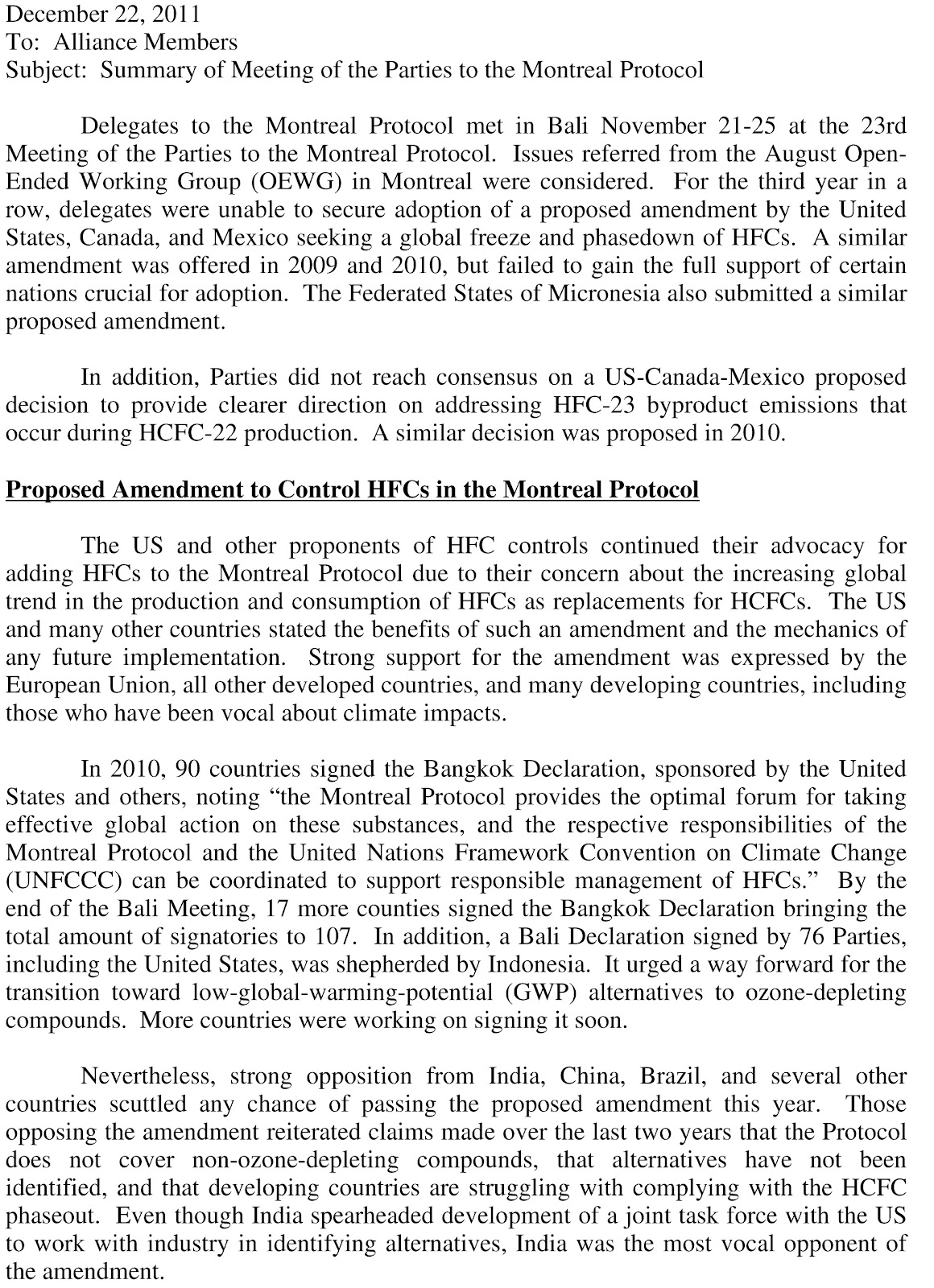
Summary of Meeting of the Parties to the Montreal Protocol


Halt on gas import

Samisoni Nabilivalu
Friday, December 23, 2011

THE Department of Environment has revealed that a batch of Refrigerant 134A (R134A) sold locally is actually not 100 per-cent R134A.

The imported refrigerant is used in the car air conditioning systems and commercial and domestic refrigeration.

According to the packaging, the cylinder contains R134A but tests conducted by Seru Ramakita, an Ozone Depleting Substances Inspector with Department of Environment, have proven otherwise.

Mr Ramakita made the discovery by accident earlier this year when demonstrating the use of a refrigerant identifier to customs officers at a workshop in Lautoka.

"The R134A I used for the demonstration was not 100 per cent," he said.

"It was cross contaminated with chlorofluorocarbon and hydro chlorofluorocarbons.

"I kept the discovery to myself because it was a big issue.

"I needed more evidence before we could make any moves and I was hoping one of the companies would bring it up as well."

Lincoln Refrigeration Limited director Praveen Singh was the first to approach Mr Ramakita after the processors for some of their fridges kept burning out.

Mr Singh said he suspected the R134A was inferior and Mr Ramakita confirmed his suspicions after he tested the gas.

"We also supply gas and we've never had this problem before.

"We had a shortage of gas, so we bought the R134A from another supplier," Mr Singh said.

Mr Ramakita confirmed all importers, wholesalers, and retailers of the product had been instructed to halt imports and remove the refrigerant from their shelves as investigations continue.

He said many businesses would have suffered unnecessarily if the product had continued to be used.

Mr Ramakita would not identify the manufacturer or local supplier of the product.